


Bathroom Organisers and the Weight Problem Nobody Warns You About
Most bathroom organisers fail for one reason: they were loaded heavier than their mount or surface could hold. A rack rated for light bottles gets stacked with full shampoo, glass jars, and a wet towel, then it sags, peels, or crashes. Before you buy, think about weight the way an engineer would. Here is how.
The load creeps up on you
An empty organiser feels light. Then you fill it. A full shampoo bottle, a large body wash, a glass jar of cotton, and a heavy conditioner add up faster than you expect. Bathroom products are dense because they are mostly liquid. A shelf that looked sturdy in the shop can be carrying several kilos once it is doing real work. The failure is rarely sudden. It starts with a slow sag or a mounting tape that lifts at one corner.
Match the mount to the wall, not the ad
Adhesive mounts, suction cups, and drilled brackets each hold very differently, and the wall matters as much as the mount. Suction needs a smooth, non-porous surface like glass or glossy tile to seal. It fails on textured tile and grout lines. Adhesive needs a clean, dry, smooth surface and time to cure before loading. Drilled brackets hold the most but need the right anchor for the wall type.
- Smooth tile or glass: suction can work for light loads.
- Textured tile or painted wall: adhesive or drilling is safer.
- Heavy daily load: drill into a solid substrate with proper anchors.
Where the weight actually pulls
A wall-mounted shelf does not just carry weight down. It also pulls out at the top, because the load sits away from the wall. This leverage is why the top edge of an adhesive strip peels first. The further your products sit from the wall, the harder that pull. A deep shelf loaded at the front edge is the classic failure. Keep heavy items pushed toward the wall to reduce the leverage.
Freestanding is not automatically safer
A tower or caddy that stands on the floor or counter avoids mounting worries but introduces a tipping risk. A tall, narrow caddy with all the heavy bottles on the top tier becomes top-heavy and topples when knocked. The rule is the same as any bookshelf: heavy at the bottom, light at the top. A wide base beats a tall, slim one for stability.
Wet weight is heavier than dry weight
People forget water. A soaked loofah, a dripping bottle, or a wet towel weighs more than its dry version, and it adds humidity that weakens adhesive over time. If an organiser sits inside the shower zone, assume it will always carry wet weight and pick a mount and material that handle both load and moisture. Rust-prone metal and water-logged particle board are where these systems age fastest.
How we think about it at R-Casa
Our position is that an organiser is only as good as its weakest link, which is usually the mount or the balance point, not the shelf itself. Choose based on what you will realistically load, then leave headroom. A shelf you never trust with a full bottle is not really solving your problem.
The short version
Estimate the loaded weight, not the empty weight. Match the mount to your actual wall. Keep heavy items low on freestanding units and close to the wall on mounted ones. Respect wet weight in the shower zone. Do that and your organiser stays up instead of ending up in the bin.
Frequently asked questions
Why do adhesive bathroom organisers keep falling off? Usually the surface was textured, damp, or not cured long enough before loading, or the load exceeded the rating. Clean, dry, smooth surfaces and a full curing time before use make a big difference.
Are suction cup organisers reliable? Only on smooth, non-porous surfaces like glass or glossy tile, and only for light loads. On textured tile or over grout lines they lose their seal and fall.
How do I stop a freestanding caddy from tipping? Keep the heaviest bottles on the lowest tier and choose a unit with a wide, stable base. Top-heavy towers tip when bumped.
Does humidity really affect how long an organiser lasts? Yes. Constant moisture weakens adhesives, rusts unprotected metal, and swells low-grade board. Inside the shower zone, choose materials and mounts built for wet conditions.
Related Posts
-
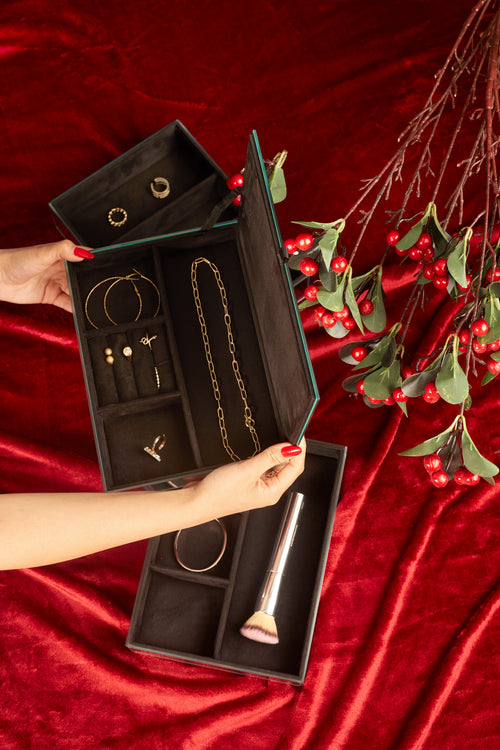
Jewellery Box vs Organiser Box: Which One Your Collection Actually Needs
If you are searching for a jewellery box organiser, you are really choosing between two different jobs. One protects....
-
Real Leather vs Leatherette Tissue Box: How to Tell
If you want a leather tissue box that ages well, the first thing to check is what kind of leather it actually is. Mos...
-
Buy Luxury Home Decor Online in India: A Complete Guide
This blog provides comprehensive knowledge on transforming your living space into a luxury haven with online luxury h...
