


The Grid vs the Nest: Why Some Jewellery Organiser Boxes Ruin Fine Chains
If your delicate chains keep coming out kinked and your studs keep escaping, the problem is rarely you. It is the internal layout of your jewellery organiser box. Most boxes fall into one of two design families, and each one protects a different kind of piece. Choose the wrong family for your collection and you will fight it every day.
The two layouts that decide everything
The first is what we call the grid. Think uniform square compartments in neat rows, often lined with foam or velvet, sometimes with a padded lid. Grids are precise. Each cell gives a small item its own home. The second is the nest, a mix of larger open trays, ring rolls, hanging hooks and long channels. Nests are generous. They give bigger, tangle-prone items room to lie flat or hang straight.
The mistake buyers make is judging a box by its outside. A beautiful lid tells you nothing about whether your favourite necklace will survive a week inside it. The layout does.
What a grid does well, and where it fails
Grids are brilliant for volume in small forms. Stud earrings, single rings, small pendants and loose charms all sit neatly in their own squares. Nothing rolls into a neighbour. You can see everything at a glance, which speeds up your morning.
Grids fail with length. A fine chain dropped into a square compartment coils on itself. Every time you lift the box or open the lid, that coil shifts and tightens. Over weeks it develops kinks that never fully straighten. Bracelets with clasps do the same. If most of your collection is chains and longer necklaces, a pure grid will slowly damage them.
What a nest does well, and where it fails
The nest is built for the pieces a grid punishes. A long open channel lets a chain lie almost flat. A row of hooks lets necklaces hang so gravity keeps them straight. A padded ring roll holds bands upright and stops them scattering. If you own statement necklaces, layered chains or delicate bracelets, a nest layout keeps them wearable.
Where the nest struggles is with small, numerous items. Drop twenty stud backs into an open tray and you get a jumble. Nests reward editing. They work best when you do not own a hundred tiny things.
How to read a layout before you buy
You usually cannot touch the box online, so read the interior photo like a floor plan. Count the small compartments and estimate their depth. Look for at least one long open section or a set of hooks if you own chains. Check whether ring storage is a roll or just another square, because rings sit better in a roll. Notice the lining too. A soft, non-abrasive lining matters more for polished metal than any decorative detail on the lid.
Our own view at R-Casa is that most people are best served by a hybrid: some grid squares for studs and rings, plus at least one long channel or a hook row for chains. A box that only does one thing forces you to store some jewellery badly.
Match the box to your habits, not your dream collection
Buy for what you actually wear, not for the collection you imagine owning one day. If you rotate the same five pieces, you do not need forty compartments sitting empty and collecting dust. If your everyday pieces are chains, prioritise flat channels and hooks even if it means fewer little squares. The best organiser is the one that makes putting jewellery away feel effortless, because the pieces that never get put away are the ones that get lost or damaged.
A quick test before you commit
Picture your three most-worn items going into the box, then picture taking them out in a hurry. Does the chain come out straight? Does the ring stay put? Do the studs have a home where they will not vanish? If the answer is yes to all three, the layout suits you. If not, keep looking, no matter how pretty the lid is.
Frequently asked questions
Do I need a lined organiser box? Lining helps prevent scratches on polished metal and gemstones, so it is worth having. A soft, snag-free lining matters more than the material of the lid.
Can one box handle both chains and studs? Yes, if it is a hybrid with small compartments plus a long channel or hooks. A pure grid or a pure nest will always favour one type over the other.
Why do my necklaces still tangle in compartments? Because coiling a chain in a small square lets it shift and knot. Store chains flat in a long channel or hanging on a hook to keep them straight.
How many compartments should I look for? Match the count to your everyday pieces, not your entire collection. Empty compartments add bulk without adding value.
Is a stackable box or a single tray better? Stackable suits growing collections and small surfaces, while a single tray keeps everything visible at once. Choose visibility if you forget what you own.
Related Posts
-
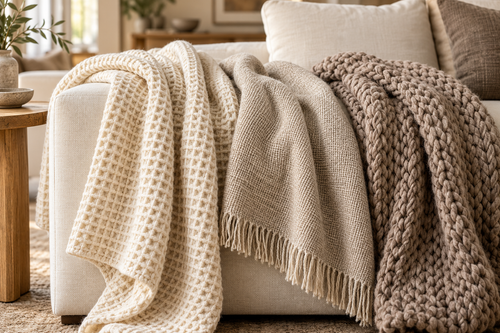
The Under-Sofa Truth About Throw Blankets: Weave, Not Just Weight
Most throw blanket guides fixate on weight. Grams per square metre, thickness, all the numbers on the tag. Here is wh...
-
Real Leather vs Leatherette Tissue Box: How to Tell
If you want a leather tissue box that ages well, the first thing to check is what kind of leather it actually is. Mos...
-
Transform Your Space with RCasa: Your Destination for Luxury Home Décor Online
When it comes to creating a home that reflects your unique taste and lifestyle, décor plays a pivotal role. At RCasa,...
-
5 Ways towards a Mood-Boosting Home with RCasa
Are you having the blues? It might be due to the colors of your room. Research on color theory says the hues we choos...
